A Confidential Investment Opportunity
Parkland Sports
Alberta’s Next Premier Indoor Turf Facility
1. Executive Summary
The Opportunity
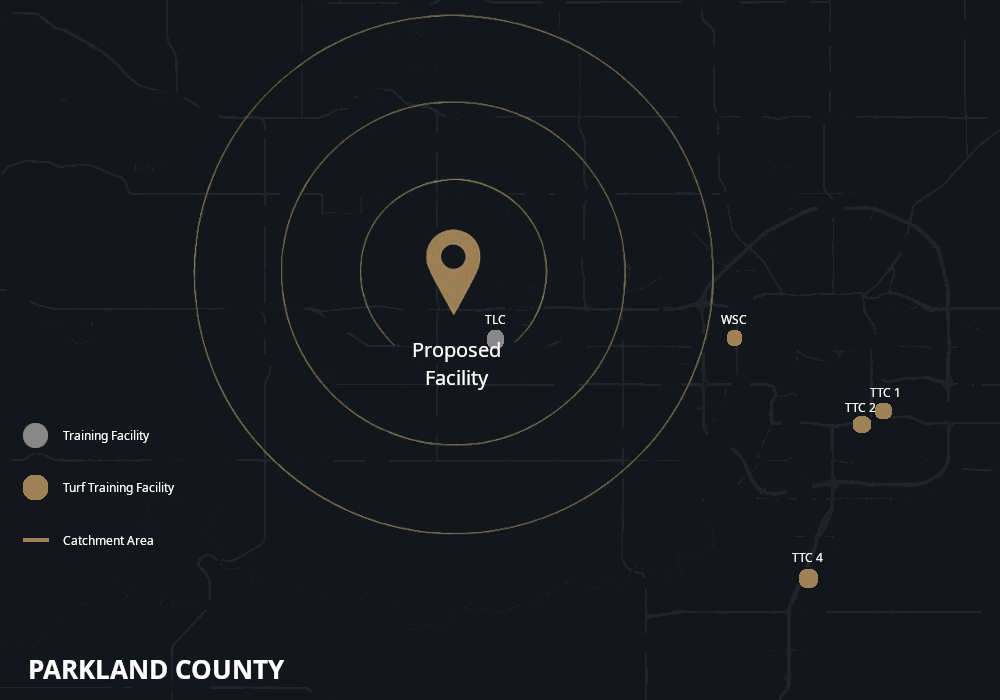
Parkland County, Alberta — one of the fastest-growing family-oriented communities west of Edmonton — has no indoor turf facility. Nearly two thousand youth soccer players and several hundred adult players compete for scarce field time at distant, overbooked venues like Tri-Leisure Center, West Soccer Center, and TTC1 & TTC2. Alberta’s harsh winters shut down outdoor play for months, yet demand for year-round training, leagues, and tournaments continues to surge. Facility utilization — not demand — is the limiting factor in this sector.
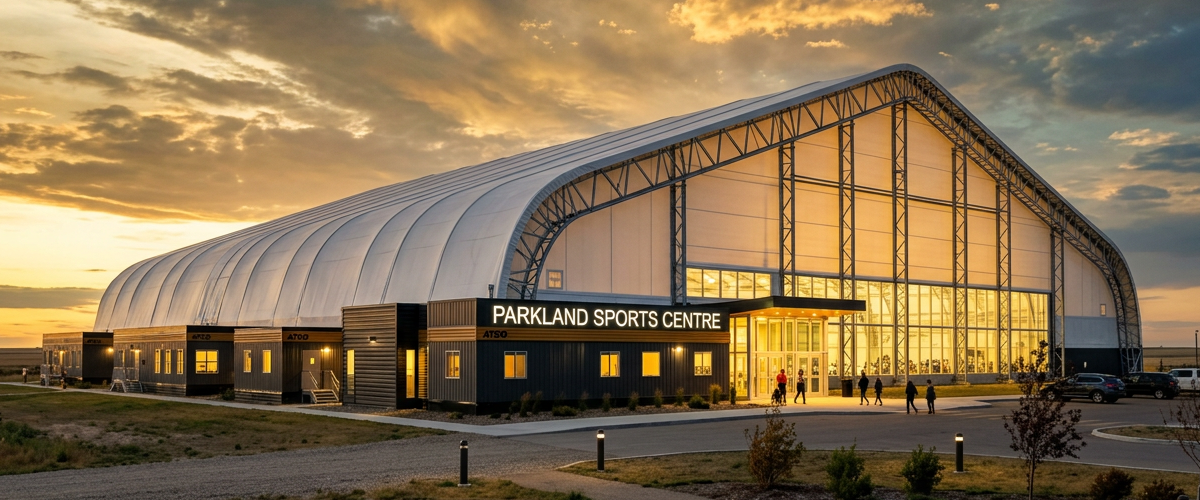
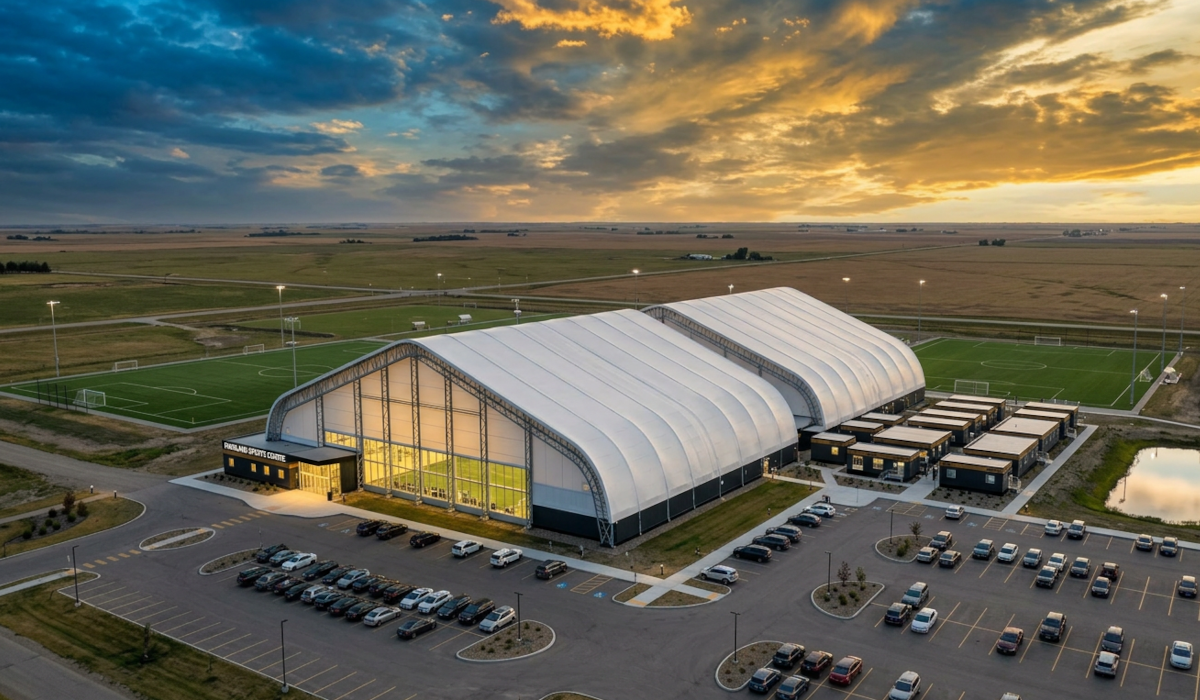
Parkland Sports Centre is the answer: a 60,000+ sq ft indoor turf facility featuring two full 9v9 fields under two double truss shelter structures, purpose-built to serve as the region’s first and only dedicated indoor turf venue. Developed and operated by Capital-SP Football Association (a society/not-for-profit) alongside Capital-SP Academy Incorporated (the for-profit operating company), this facility leverages over five years of incorporated academy operations, relationships with over 200 active players and hundreds of families, and established partnerships with Parkland School District, Spruce Grove Saints, and Parkland Fusion.
The Ask
We are seeking CAD $5,000,000 in investor capital to fund construction, turf and infrastructure, land acquisition, operations setup, and contingency. The facility is projected to generate $1.6M+ in gross annual revenue from field rentals alone — benchmarked at $800,000+ per field — before academy programming, tournaments, concessions, merchandise, and sponsorship revenue.
Projected Returns
Investors can expect ~9% annual return (base case) through a loan-with-interest structure over a 5–7 year term, with 12–15%+ upside potential through increased utilization, sponsorship revenue, and tournament expansion. This is a conservative, cash-flow-first investment with immediate revenue generation and proven demand. Construction begins July 2026 with doors open no later than November 2026.
This is not simply an investment in a building. It is a partnership with the only organization that possesses the community trust, soccer expertise, supplier relationships, and operational infrastructure to make this facility a reality. Capital-SP is the essential partner — and this document will demonstrate why. The two-field model unlocks existing demand through increased capacity — not speculative growth.
2. Vision & Opportunity
The Vision
A continuously accessible turf sport facility that transforms Parkland County into a year-round soccer hub — improving access, performance, and opportunity for youth players aged 6–18 and beyond.
The Mission
Year-round training and leagues for youth soccer, delivered through a self-sustaining facility model that uses its income to fund growth, expansion, and community impact.
Core Values
- Development — Player growth at every level
- Dedication — Commitment to excellence in programming and operations
- Commitment — Long-term investment in community and sport
The Market Gap
Parkland County and its surrounding communities represent a significant underserved market for indoor turf facilities:
- Nearly 2,000 youth soccer players in the catchment area, with numbers continually growing
- Several hundred adult players participating in soccer alone
- Fast-growing young families spearheading population growth and demand for youth programming
- Zero dedicated indoor turf facilities currently operating in Parkland County
- Chronic field shortages — field time is extremely difficult to secure during peak seasons
- Alberta’s climate demands indoor facilities for 5–6 months of the year, yet existing options (Tri-Leisure Center, West Soccer Center, TTC1 & TTC2) are distant, overbooked, and expensive
- Facility utilization — not demand — is the limiting factor in this sector; the two-field model directly addresses this constraint
Why Now
The window of opportunity is narrow. Capital-SP’s primary competitive concern is that delays could allow a competitor to deliver a similar facility first. The first mover in this market captures the community relationships, booking commitments, and brand loyalty that create a durable competitive advantage. Capital-SP already holds these relationships — the facility is the missing piece.
3. Why Capital-SP: The Essential Partnership
“This isn’t just an investment in a building — it’s a partnership with the only team that can make this work.”
The Capital-SP Advantage
Building an indoor turf facility is a construction project. Making it succeed is an entirely different challenge — one that requires deep roots in the soccer community, operational expertise, established programming, and trusted relationships that take years to build. Capital-SP brings all of this to the table. No other organization in Parkland County can replicate it.
Established Community Trust
Capital-SP Academy has operated for several years (five years incorporated), serving over 200 players annually across multiple programs in Alberta alone. Hundreds of families trust Capital-SP with their children’s athletic development. This trust doesn’t transfer to a building — it transfers to the people and organization behind it.
- Parkland School District — established partnership
- Spruce Grove Saints — established partnership
- Parkland Fusion — established partnership
- Letters of intent from clubs and schools confirming willingness to rent field time
- Municipal engagement — introductory meetings with local government already underway
The Dual-Entity Strategic Advantage
Capital-SP’s structure is deliberately designed to maximize both community impact and investor returns:
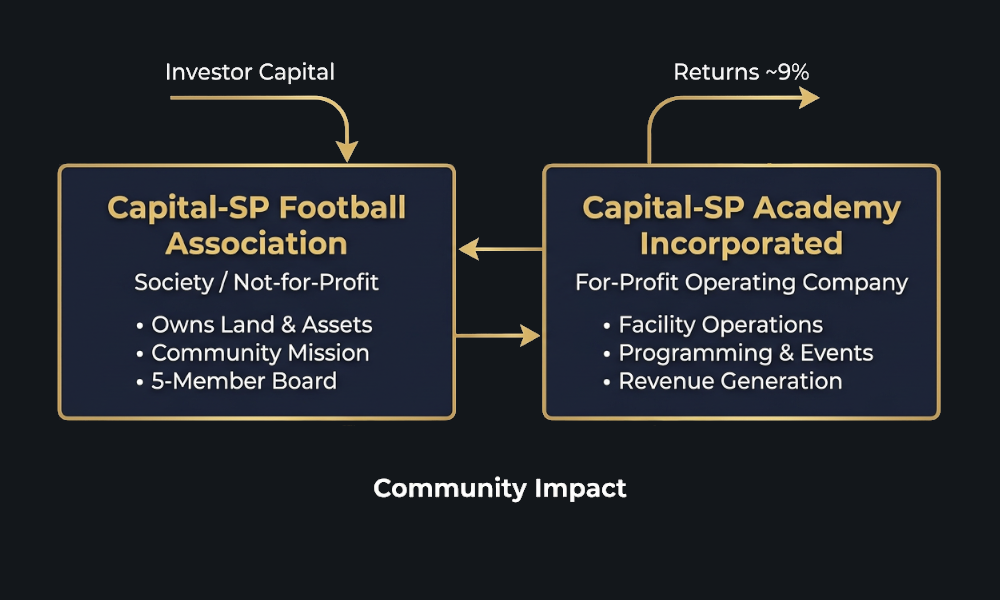
- Capital-SP Football Association (society/not-for-profit) — Owns the land and major improvements. Governed by a 5-member board with expertise in finance, construction, legal, and administration. The not-for-profit structure enables community trust, potential future grant access, and tax-efficient operations.
- Capital-SP Academy Incorporated (for-profit operating company) — Serves as the anchor tenant and operational engine. Generates revenue through programming, events, and facility management. Provides the commercial discipline and accountability investors require.
This structure ensures that community mission and financial returns reinforce each other rather than compete. The society protects the asset and community purpose; the operating company drives revenue and efficiency.
Irreplaceable Operational Expertise
Capital-SP’s leadership team brings direct, relevant experience:
- Alex — Coaching, management, academy operations
- Carl — Coaching, management, events
The academy currently spends over $50,000 annually (heavily subsidized) on renting 1,100+ field hours from other facilities. This represents built-in demand that immediately transfers to the new facility — demand that no competing developer could capture without Capital-SP’s participation.
Exclusive Programming & Revenue Streams
Capital-SP’s established programming creates revenue streams that are exclusive to this partnership:
- 3v3 Futbol Cup — Established tournament (approximately 120 participants per edition, limited only by current space/booking constraints)
- Indy Skillz Championship — Established tournament (approximately 120 participants per edition)
- Academy training programs — Multiple programs running year-round
- School partnerships — Direct pipeline to Parkland School District programming
- Homeschool Physical Education — Specialized programming for homeschool families
- Camping & RV Summer Break Tournaments — Unique event programming
Why This Cannot Be Replicated Independently
An investor considering an independent facility development would face:
- No community relationships — Years of trust-building cannot be purchased or fast-tracked
- No anchor tenant — The academy’s 1,100+ hours of annual demand provides a revenue floor
- No programming expertise — Tournament organization, coaching networks, and curriculum development require specialized knowledge
- No school/club partnerships — These relationships are personal and institutional, built over years
- No operational team — Recruiting qualified soccer operations leadership in Parkland County would be extremely difficult
- No brand recognition — Capital-SP is a known and trusted name in the community
Capital-SP is not just a partner — Capital-SP is the venture. The facility is the infrastructure; Capital-SP is the engine that makes it profitable.
4. The Facility Plan
Location
Parkland County, Alberta, Canada. Capital-SP has identified preferred sites (multiple options under consideration), all adjacent to access roads with strong visibility. The site will be owned by Capital-SP Football Association, providing long-term asset security for investors.
Phase 1 Facility — The Core
| Component | Specification |
|---|---|
| Total Indoor Area | 60,000+ sq ft |
| Primary Fields | Two full 9v9 indoor turf fields |
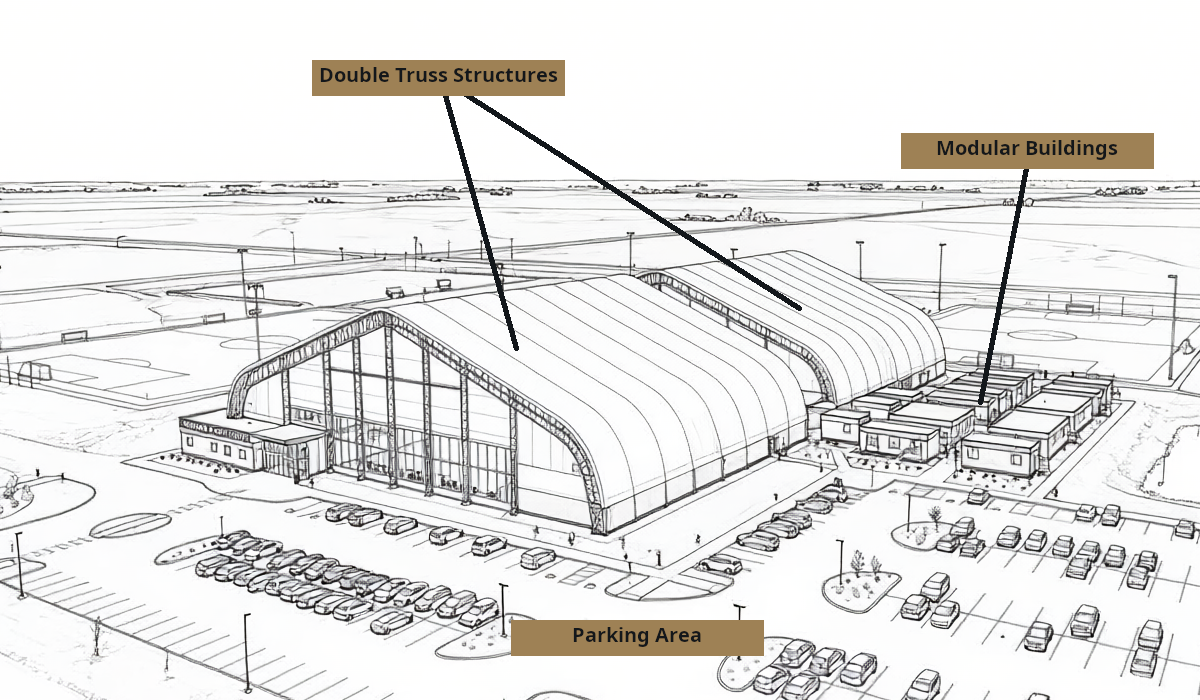
| Structure Type | Two double truss shelter structures — rapid deployment, cost-effective |
| Support Spaces | Change rooms, meeting/waiting areas, offices |
| Fitness Areas | Treadmill room, stretching area/gym |
| Parking | ~120 stalls adjacent to entrance/road |
| Operating Hours | Weekdays 6am–12am (18 hrs); Weekends 6am–1am (19 hrs) |
Key Advantage — Parallel Programming: Two fields operating simultaneously enables league play + training running at the same time, peak-hour maximization with no idle field time, reduced scheduling conflicts and lost bookings, and immediate revenue from both fields on day one.
Phase 2 — Expansion (Within 2 Years of Opening)
- RV & camping facilities (on-site accommodation for tournament teams and families)
- Playground and family recreation zones
- Open green spaces
- Multiple outdoor pitches:
- Full-size 11v11
- 9v9
- 7v7
Future Phases — Tournament & Regional Hub
- Full-size outdoor 11v11 artificial turf field (lit) for evening and tournament play
- Expanded event infrastructure
- Regional tournament destination positioning
- Multi-sport adaptability
- Long-term asset appreciation
Design Philosophy
The phased approach — starting with two double truss shelter structures and modular support buildings — is a deliberate strategic choice. It allows Capital-SP to:
- Open quickly — Meet the November 2026 deadline and capture first-mover advantage
- Minimize upfront capital risk — Prove the revenue model before committing to permanent construction
- Scale with demand — Add capacity as utilization data confirms market appetite
- Preserve flexibility — Adapt the facility layout based on actual usage patterns
- Maximize revenue from day one — Two fields operating in parallel eliminates idle time and doubles revenue capacity
5. Building Solutions — Our Strategic Approach
Capital-SP’s building strategy reflects deep research, cost optimization expertise, and pragmatic phasing. Rather than committing to a single expensive permanent structure, we deploy a combination of building technologies — each chosen for its specific advantages at each phase of development.
5.1 Double Truss Shelters — The Phase 1 Powerhouse
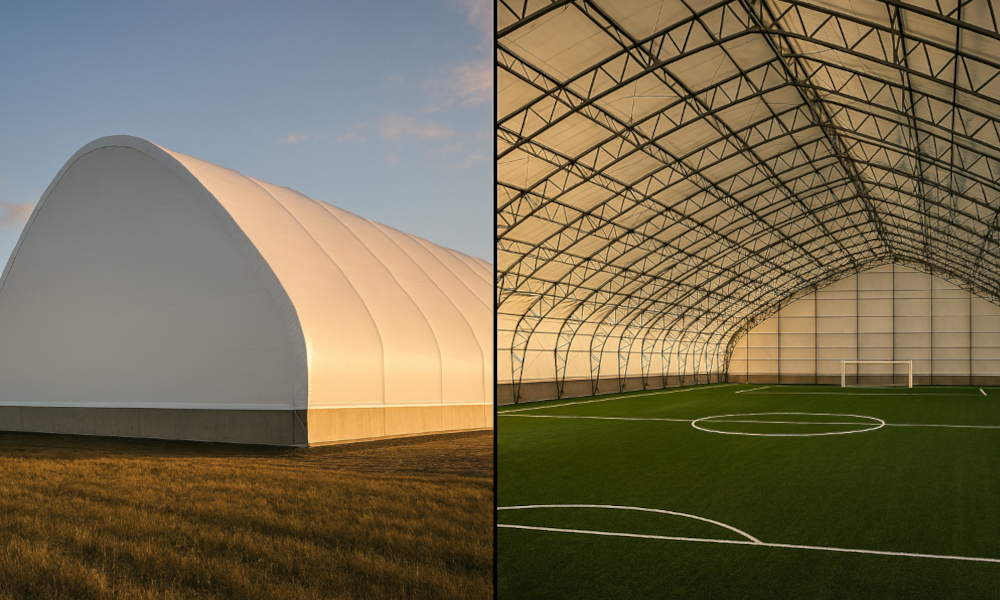
The primary facility structures will be two double truss shelters — semi-permanent to permanent structures built using steel or aluminum truss frames with heavy-duty PVC fabric covering. This is what Capital-SP refers to as “tentage to start,” and it represents the smartest Phase 1 choice for several compelling reasons. Both structures can be erected in parallel, enabling both fields to open simultaneously.
Why Double Truss Shelters for Phase 1
- Rapid deployment — Significantly faster to erect than conventional buildings, enabling the July–November 2026 construction timeline; both structures erected in parallel
- Cost-effective — Lower cost per square foot compared to traditional steel or concrete construction
- Clear-span interiors — No interior columns, maximizing the full field area for each 9v9 field
- Natural light — Translucent fabric allows daylight penetration, reducing energy costs
- Scalable — Modular design allows for expansion as demand grows
- Relocatable — Can be disassembled and moved if site strategy evolves
- Minimal site preparation — Less foundation work than traditional buildings
- Engineered for Alberta conditions — Designed to handle local wind and snow load requirements
- Parallel programming — Two structures enable simultaneous league play and training, maximizing peak-hour revenue
Specifications for Capital-SP’s Facility
| Specification | Detail |
|---|---|
| Configuration | Two double truss shelter structures |
| Width per Structure | 100’+ clear-span (available from ClearSpan, Britespan, Norseman) |
| Total Footprint | 60,000+ sq ft combined |
| Peak Ceiling Height | 12–23 feet typical |
| Truss Spacing | 10 feet on center |
| Truss Gauge | 16 GA steel |
| Fabric | 21 oz / 450 GSM heavy-duty PVC, triple-layered |
| Warranty | Up to 50-year frame warranty, 20-year overall (ClearSpan) |
Pricing Context
- Basic fabric structures: $2.65–$10/sq ft (structure only)
- Mid-range (ClearSpan/Britespan class): $10–$25/sq ft
- Premium fully installed: $20–$30/sq ft
- Fully finished indoor sports facility (including turf, HVAC, etc.): $100–$300+/sq ft
- For reference: An air-supported seasonal dome for 1/3 field was estimated at ~$1,067,000 in a 2022 municipal feasibility study
Key Manufacturers Under Consideration
- ClearSpan Structures — Leading manufacturer; Econoline Truss Buildings in 50’ and 70’ widths, up to 100’+ long; 50-year frame warranty
- Britespan Building Systems — Canadian manufacturer; column-free clear-span designs; sports and recreation specialty
- Norseman Structures — Canadian manufacturer; steel-framed, fabric-covered buildings
5.2 ATCO Trailers / Modular Buildings — Rapid-Deploy Support Facilities
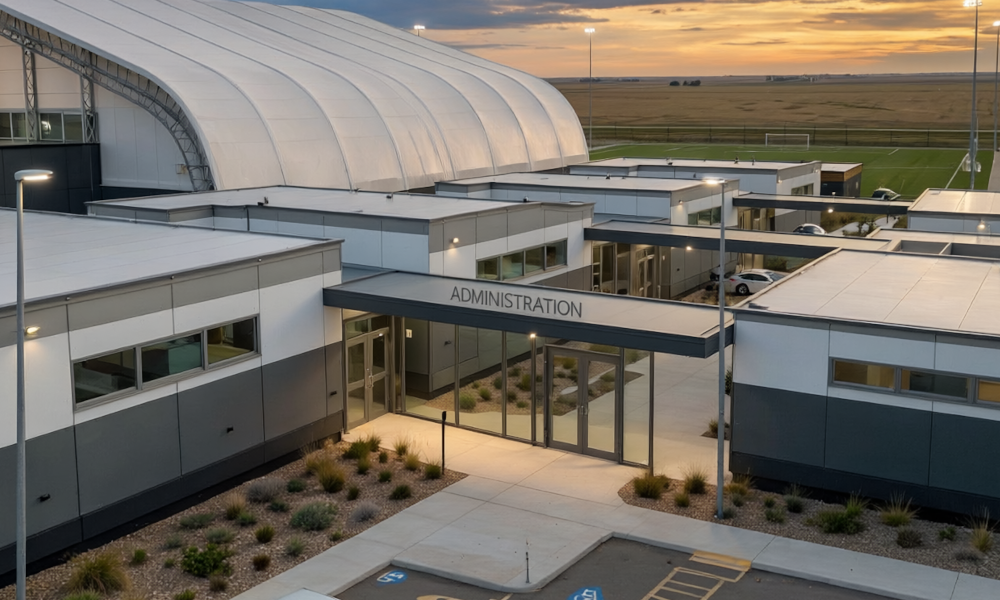
For administrative offices, change rooms, meeting spaces, and ancillary facilities, Capital-SP will deploy modular buildings — leveraging the proven ATCO/modular building approach that Alberta’s industrial sector has relied on for over 75 years.
Planned Modular Deployments
| Function | Configuration | Estimated Cost |
|---|---|---|
| Administrative Office | 12’ x 60’ mobile office trailer | $30,000–$50,000 (purchase) or $700–$1,200/mo (lease) |
| Change Rooms / Washrooms | 10’ x 32’ premium trailer with washroom | Up to $1,600/mo (lease) or ~$20,000+ (purchase used) |
| Meeting / Waiting Area | 10’ x 40’ mobile office | ~$20,000 (purchase used) or ~$500–$650/mo (lease) |
Why Modular for Support Spaces
- Turnkey solutions — Fully furnished and equipped, ready for immediate use
- Rapid deployment — Manufactured off-site and delivered ready to occupy
- Mobility — Can be relocated or reconfigured as the facility evolves
- Cost-effective — Dramatically lower upfront costs compared to permanent construction
- Lease flexibility — Option to lease initially and purchase or upgrade later
- Alberta expertise — ATCO is headquartered in Calgary; deep local supply chain
Market Context
ATCO Structures, headquartered in Calgary, Alberta, has over 75 years in the modular building industry and operates across four continents. The North American modular construction market was valued at USD $10.53 billion in 2022 with expected growth of 7.8% CAGR through 2030. This is a mature, reliable supply chain.
5.3 Pole Barn Construction — The Future Phase Permanent Option
As Capital-SP’s facility proves its revenue model and expands, pole barn (post-frame) construction offers a cost-effective path to permanent structures for Phase 2 and beyond.
Why Pole Barns for Future Phases
- 40–60% less expensive than conventional construction
- Fast construction — Days to weeks vs. months for traditional buildings
- Large clear-span interiors — Up to 100’+ widths with engineered trusses, no interior load-bearing walls
- Durable — 40–60+ year typical lifespan
- Expandable — Relatively easy to extend or modify
- Engineered for local codes — Designed to meet Alberta wind and snow load requirements
Pricing Context for Future Planning
| Configuration | Cost Range |
|---|---|
| Basic shell | $15–$45/sq ft |
| Mid-range with finishing | $25–$60/sq ft |
| Fully finished commercial | $35–$85/sq ft |
| 60’ x 100’ kit | $54,000–$78,000+ |
| 60’ x 80’ x 16’ commercial spec | ~$71,000 |
Potential Future Phase Applications
- Permanent replacement or supplement to the truss shelter main facility
- Additional field enclosures
- Permanent change room and clubhouse facilities
- Equipment storage and maintenance buildings
- Expanded fitness and performance center
5.4 The Strategic Combination — Evidence of Capital-SP’s Expertise
This three-technology approach is not accidental. It reflects Capital-SP’s strategic thinking and cost optimization expertise:
| Phase | Technology | Purpose | Advantage |
|---|---|---|---|
| Phase 1 (2026) | 2x Double Truss Shelters + ATCO Modular | Two fields + support facilities | Speed, cost, parallel programming |
| Phase 2 (2028) | Outdoor pitches + RV/camping + recreation | Expanded amenities + lifestyle | Proven demand, diversified revenue |
| Phase 3+ | Permanent construction + lit 11v11 field | Full tournament complex buildout | Revenue-funded growth |
This phased building strategy keeps the initial $5M budget realistic while creating a clear path to a multi-field, full-service sports complex — all funded by the facility’s own revenue generation.
6. Business Model & Revenue Projections
Revenue Model Overview
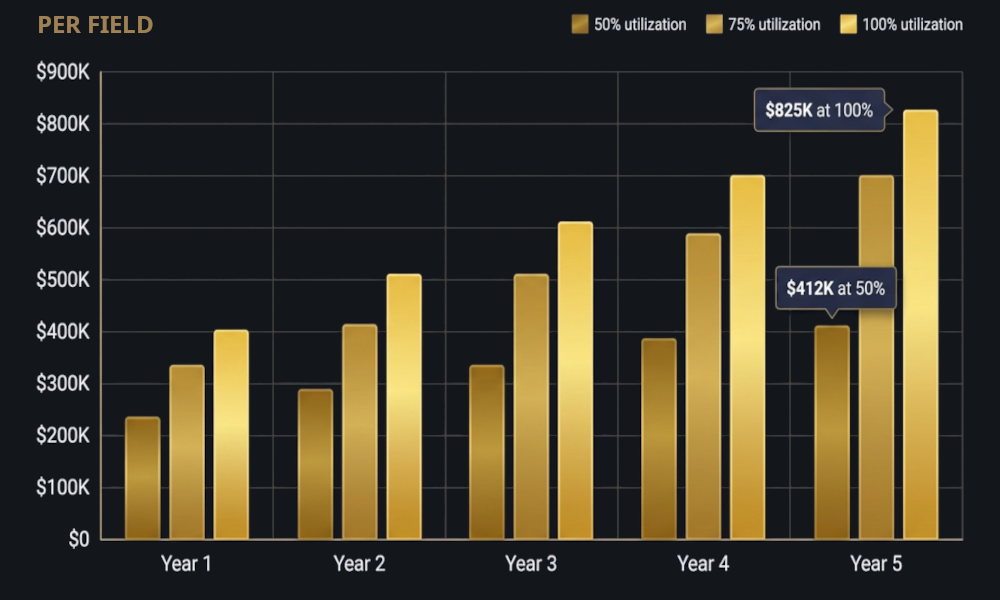
Capital-SP’s revenue model is built on a diversified foundation with field rentals as the primary driver, supplemented by programming, events, and ancillary services. With two fields operating simultaneously, the facility achieves $800,000+ revenue per field, totaling $1.6M+ annually — based on competitive pricing benchmarks and high utilization scheduling. Industry benchmarks confirm that rentals + leagues = ~65–80% of revenue, and 60–80% utilization is required for strong profitability.
Primary Revenue: Field Rentals
The facility operates on a tiered hourly rental model reflecting market-standard pricing for the region:
| Time Period | Hours | Rate/Hour | Description |
|---|---|---|---|
| Pre Prime-Time | 6am–5pm (weekdays) / 6am–9am (weekends) | $50/hr | Schools, homeschool programs, daytime training |
| Prime-Time | 5pm–10pm (weekdays) / 9am–9pm (weekends) | $225/hr | Club training, leagues, competitive programs |
| Post Prime-Time | 10pm–12am (weekdays) / 9pm–1am (weekends) | $100/hr | Adult rec leagues, late training sessions |
Regional pricing context: Comparable indoor turf in the region currently charges $100–$250/hr. Capital-SP’s tiered model captures the full market — from budget-conscious daytime users to premium prime-time demand.
Weekly Hours Breakdown (Per Field)
| Period | Weekday Hours | Weekend Hours | Total Weekly Hours |
|---|---|---|---|
| Pre Prime-Time | 11 hrs/day × 5 = 55 | 3 hrs/day × 2 = 6 | 61 hours |
| Prime-Time | 5 hrs/day × 5 = 25 | 12 hrs/day × 2 = 24 | 49 hours |
| Post Prime-Time | 2 hrs/day × 5 = 10 | 4 hrs/day × 2 = 8 | 18 hours |
| Total per Field | 90 hrs | 38 hrs | 128 hours/week |
Two-Field Total: 256 hours/week available
Revenue Projections at 100% Utilization (Two Fields)
| Period | Hours/Week (2 fields) | Rate/Hour | Weekly Income | Monthly Income* | Yearly Income |
|---|---|---|---|---|---|
| Pre Prime-Time | 122 | $50 | $6,100 | $26,413 | $317,200 |
| Prime-Time | 98 | $225 | $22,050 | $95,477 | $1,145,700 |
| Post Prime-Time | 36 | $100 | $3,600 | $15,588 | $187,200 |
| Total | 256 | — | $31,750 | $137,478 | $1,650,100 |
*Monthly based on 4.33 weeks per month (52 weeks ÷ 12 months)
Utilization Scenarios
Based on Capital-SP’s market knowledge and booking projections:
| Metric | Year 1 | Year 3 | Year 5 |
|---|---|---|---|
| Prime-Time Utilization | 50% | 70% | 95% |
| Non-Prime Utilization | 60% | 75% | 90% |
Secondary Revenue Streams
| Revenue Stream | Description | Status | Contribution |
|---|---|---|---|
| Academy Programming | Year-round training, camps, clinics | Established — transferring from current operations | Core base |
| Leagues | Seasonal team registrations across both fields | Established — currently limited by space | High recurring |
| Tournaments & Events | 3v3 Futbol Cup, Indy Skillz Championship, new events | Established — currently limited by space | Peak revenue |
| Café / Concession | Food and beverage service | Planned — potentially third-party vendor | Incremental |
| Merchandise / Pro Shop | Equipment and apparel sales | Planned — potentially third-party vendor | Incremental |
| Sponsorships & Naming Rights | Field naming, tournament sponsorship, facility advertising | Planned | Scalable |
| Room / Space Rentals | Meeting rooms, party rooms, event space | Planned | Incremental |
| Homeschool Physical Education | Specialized daytime programming | Planned — fills pre-prime hours | Core base |
| Camping & RV Summer Tournaments | Unique seasonal event programming | Planned | Peak revenue |
Built-In Demand Floor
Capital-SP Academy currently rents 1,100+ field hours annually at a heavily subsidized cost of $50,000+ from other facilities. This demand transfers directly to the new facility on day one, providing a revenue floor before any external bookings. With two fields, the academy’s demand occupies a fraction of total capacity, leaving the majority available for external revenue.
Revenue Constraint Explanation
Current revenue is artificially limited due to insufficient field capacity, inability to run simultaneous programs, and lost bookings from unmet demand. The two-field model directly unlocks increased scheduling density, higher utilization rates, and immediate revenue growth from parallel programming.
7. Financial Plan & Investment Structure
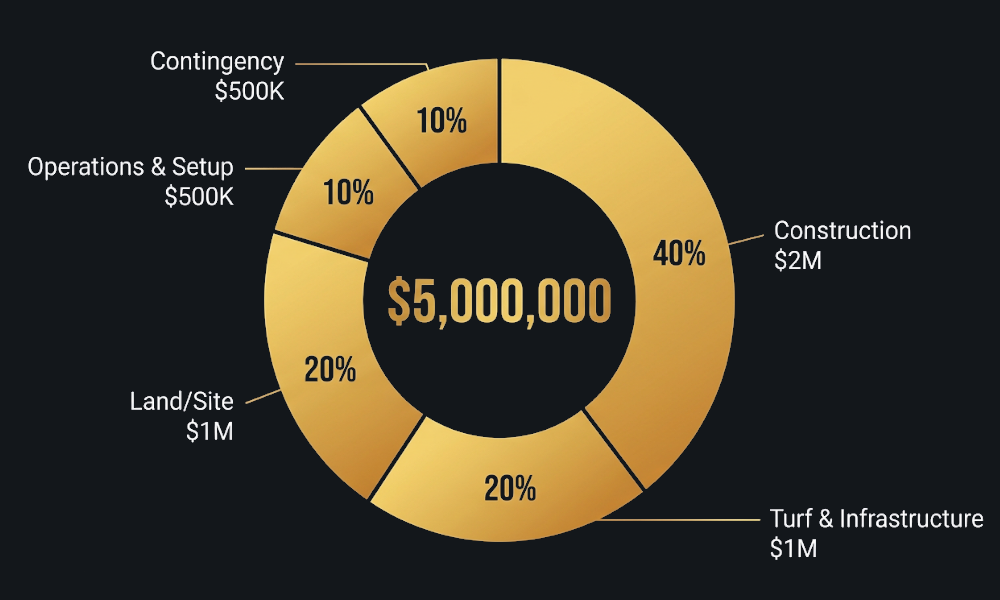
Capital Budget — $5,000,000
| Category | Amount | % of Total | Description |
|---|---|---|---|
| Construction | $2,000,000 | 40% | Two double truss shelter structures + modular support buildings |
| Turf & Infrastructure | $1,000,000 | 20% | Two indoor turf systems, goals, barriers, fitness equipment, utilities |
| Land / Site | $1,000,000 | 20% | Site purchase and preparation in Parkland County |
| Operations & Setup | $500,000 | 10% | Technology systems, initial operating capital, staffing setup |
| Contingency / Other | $500,000 | 10% | Cost overrun protection and working capital |
| TOTAL | $5,000,000 | 100% |
Funding Structure
| Source | Amount | Notes |
|---|---|---|
| Investor Capital | $5,000,000 (100%) | Phase 1 funding — all investor capital |
| Grants | $0 (Phase 1) | Grants and loans targeted for Phase 2 and beyond |
| Debt/Loans | $0 (Phase 1) | Loans targeted for Phase 2 and beyond |
Investor Return Structure
| Parameter | Detail |
|---|---|
| Instrument | Loan with interest (open to negotiation or alternative structures) |
| Investment Term | 5–7 years |
| Target Annual Return (Base Case) | ~9% per year |
| Upside Scenario | 12–15%+ (increased utilization, sponsorship, tournament expansion) |
| Payment Profile | Conservative, cash-flow-first with steady payments |
| Exit Options | (1) Buyout by operating entity; (2) Continued revenue participation; (3) Reinvestment into expansion phases |
Financial Projections (5–7 Year Model)
Detailed financial projections are provided in Appendix A. Key highlights:
| Year | Revenue | Notes |
|---|---|---|
| Year 1 | $1.2M–$1.4M | Ramp-up period |
| Year 2 | $1.6M+ | Stabilized operations |
| Year 3–5 | $1.6M–$1.8M | Optimization and growth |
| Year 5–7 | Growth | Expansion phases |
Additional revenue from programming, events, concessions, and sponsorships not included in base projections.
Sensitivity Analysis
If revenues are 20% lower than expected:
- First lever: Raise off-peak utilization through expanded hours, adjusted pricing, and aggressive marketing across all customer segments; parallel field scheduling enables flexible programming
If costs are 20% higher than expected:
- Second lever: Increase sponsor and grant acquisition focus to supplement revenue
8. Implementation Roadmap & Timeline
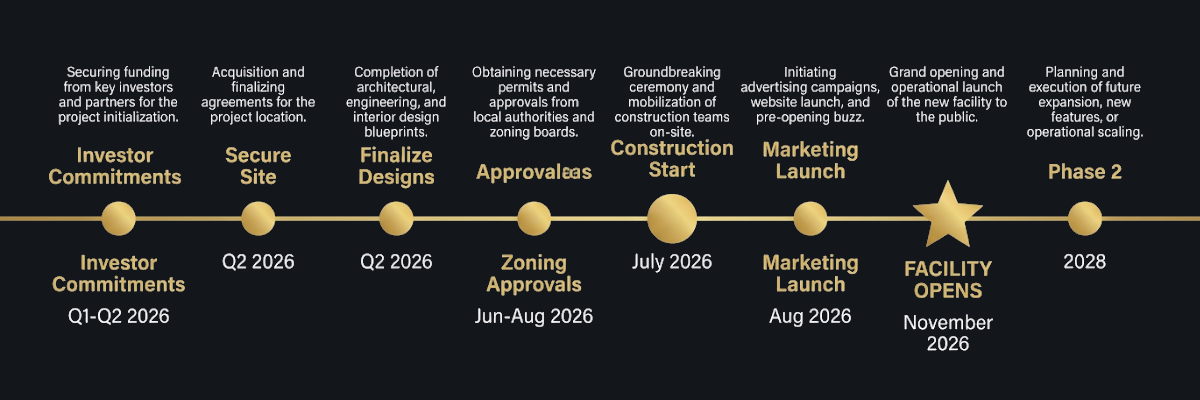
Critical Path Timeline
| Milestone | Target Date | Status |
|---|---|---|
| Confirm investor commitments | As soon as possible | Active — seeking commitments now |
| Secure site | Q2 2026 | Preferred sites identified |
| Finalize designs | Q2 2026 | Conceptual planning underway |
| Confirm construction materials delivery | Q2 2026 | Supplier research complete |
| Confirm city/county requirements and zoning | June–August 2026 | Initial municipal engagement complete |
| Confirm vendors | Q2 2026 | Research and evaluation underway |
| Construction Start | July 2026 | Both truss structures erected in parallel |
| Confirm clients / booking commitments | July–September 2026 | Letters of intent in hand |
| Advertising campaigns launch | August–October 2026 | |
| Confirm city/county permissions and zoning | August 2026 | |
| Facility Opens | No later than November 2026 | Both fields operational |
Current Status — What Is Already Done
- Academy operating for several years (5 years incorporated)
- 200+ active players, hundreds of families engaged
- Partnerships established with Parkland School District, Spruce Grove Saints, Parkland Fusion
- Letters/emails of intent from clubs and schools
- Municipal introductory meetings completed
- Preferred sites identified
- Building technology research completed
- Income model and financial projections developed
- Board of 5 members assembled (finance, construction, legal, administration)
- Established tournament programming (3v3 Futbol Cup, Indy Skillz Championship)
What We Are Asking Investors For Now
We are seeking whatever commitment format moves the process forward most efficiently — whether that is an information meeting, letter of intent, or draft term sheet. The goal is a confirmation of intent to invest that allows Capital-SP to proceed with site acquisition and construction planning on the July 2026 timeline.
9. Risk Analysis & Mitigation
Capital-SP approaches risk with transparency and pragmatism. The following analysis demonstrates mature risk thinking and credible mitigation strategies.
Key Risks and Mitigations
| Risk | Severity | Likelihood | Mitigation |
|---|---|---|---|
| Timing / Competitor Risk | High | Medium | Keep project details low-key; leverage existing relationships with clubs, schools, and institutions; first to open captures the market advantage |
| Construction Cost Overruns | Medium | Medium | $500K contingency (10% of budget); thorough preparation and planning; fixed-price contracts where possible |
| Construction Delays | Medium | Medium | Double truss shelter technology enables rapid parallel deployment; both structures erected simultaneously; modular buildings manufactured off-site in parallel; aggressive but achievable July–November timeline |
| Lower-Than-Expected Demand | Medium | Low | 1,100+ hours of built-in academy demand; letters of intent from clubs/schools; two fields enable parallel programming (league + training simultaneously); leverage advertising campaigns; only indoor turf in Parkland County |
| Pricing Pressure | Low | Low | Tiered pricing model accommodates all segments; regional rates of $100–$250/hr validate pricing; community partner discounts build loyalty |
| Key-Person Risk | Medium | Low | Minimized through self-contained functional operating procedures; all personnel trained to run operations if needed; cross-training protocols |
| Regulatory / Zoning Issues | Medium | Low | Municipal engagement already initiated; planning/zoning approvals targeted for June–August 2026; legal expertise on board |
| Weather / Facility Damage | Low | Low | Property and liability insurance; truss shelters engineered for Alberta wind and snow loads; maintenance schedules |
Insurance Coverage
- Property insurance — Covering the facility structure, equipment, and turf
- Liability insurance — Comprehensive coverage for operations, events, and public access
Capital Protection
The combination of the not-for-profit society owning the land and improvements, the $500K contingency reserve, diversified revenue streams, two-field parallel programming, and built-in demand from the academy provides multiple layers of capital protection for investors.
10. Social Impact & ESG
Community Impact
Capital-SP Football Association’s not-for-profit structure ensures that community benefit is embedded in the facility’s DNA — not an afterthought.
Access Programs
- Homeschool Physical Education — Dedicated programming for homeschool families, filling daytime hours while serving an underserved community
- Camping & RV Summer Break Tournaments — Unique seasonal programming that draws visitors and economic activity to Parkland County
- Reduced-Fee Community Hours — Weekly community access hours at subsidized rates
Youth Development
- Serving thousands of youth annually once the facility is operational (up from 200+ currently); two fields dramatically increase capacity
- 5–15 coaching and staff jobs created
- Scholarships and fee assistance available
- Year-round access to quality training regardless of family income
Impact Metrics — Tracked Annually
| Metric | Description |
|---|---|
| Youth Served | Total number of youth participants per year |
| Program Variance | Diversity and breadth of programming offered |
| Female Participation % | Gender equity in programming access |
| Non-Local Player Participation | Regional draw and economic impact |
Environmental Commitment
Capital-SP is committed to building a facility that meets requirements without major reconstruction or disruption to the area and the building itself. The truss shelter approach inherently supports this:
- Minimal site disruption during construction
- Translucent fabric reduces artificial lighting needs
- Modular approach minimizes waste
- Future phases can incorporate energy-efficient permanent construction
Impact Reporting
Capital-SP will share an impact report with investors and the community at least annually, covering all tracked metrics, financial performance, and community outcomes.
11. Q&A Section
About the Organization
Q: What is the legal structure of Capital-SP?
A: Capital-SP operates through two entities: Capital-SP Football Association, a society/not-for-profit that will own the land and major improvements, and Capital-SP Academy Incorporated, a for-profit operating company that manages programming and facility operations. This dual structure maximizes both community impact and investor returns.
Q: How are academy decisions separated from facility decisions?
A: Separate boards with a shared liaison member ensure clear governance boundaries while maintaining strategic alignment.
Q: How many board members govern the facility society?
A: Five board members with expertise spanning finance, construction, legal, and administration.
About the Facility
Q: Why “tentage to start” instead of a permanent building?
A: Two double truss shelters offer rapid parallel deployment (meeting our November 2026 deadline), significantly lower cost per square foot, clear-span interiors ideal for soccer, and the flexibility to expand or upgrade as revenue proves the model. Both structures can be erected simultaneously, enabling both fields to open at the same time. This is a strategic choice, not a compromise.
Q: Will the academy pay rent to the facility?
A: No. The academy serves as the anchor tenant and operational engine. Its programming drives utilization and revenue from external clients. The academy’s value is in demand generation, not rent payments.
Q: Does the academy own shares in the facility company?
A: No. The entities are structurally separate, with the society (not-for-profit) owning the land and improvements.
About the Investment
Q: What is the total funding target?
A: $5,000,000 for Phase 1, covering construction of two double truss shelters, two turf systems, land/site, operations setup, and contingency.
Q: What return can investors expect?
A: ~9% annual return (base case) through a loan-with-interest structure over a 5–7 year term. Upside scenario of 12–15%+ is achievable through increased utilization, sponsorship, and tournament expansion. Capital-SP is open to negotiation on the specific instrument and terms.
Q: What is the exit strategy?
A: Three options: (1) Buyout by the operating entity; (2) Continued revenue participation; (3) Reinvestment into expansion phases. The self-sustaining revenue model provides consistent returns without requiring a forced liquidity event.
Q: What if revenues are lower than projected?
A: The first lever is raising off-peak utilization through expanded hours, adjusted pricing, and aggressive marketing across all customer segments — two fields enable flexible parallel scheduling. The second lever is increasing sponsor and grant acquisition focus.
Q: What portion of funding comes from grants or loans?
A: Phase 1 is 100% investor capital. Grants and loans will be pursued for Phase 2 and subsequent expansions once the facility is operational and generating revenue.
About the Market
Q: Are there competing indoor turf facilities in Parkland County?
A: No. There is currently no indoor turf facility in Parkland County. The nearest options (Tri-Leisure Center, West Soccer Center, TTC1 & TTC2) are distant, overbooked, and expensive.
Q: Is field time currently hard to get?
A: Yes. Peak-season field time is extremely difficult to secure, and Capital-SP’s own tournaments are limited to approximately 120 participants each due to space and booking constraints.
Q: What is the biggest risk?
A: The primary risk is timing — the possibility that delays could allow a competitor to open a similar facility first. Capital-SP mitigates this by keeping project details confidential, maintaining strong relationships with key stakeholders, and prioritizing speed to market.
12. Appendices
Appendix A: Financial Model Tables
A.1 Revenue Projections by Utilization Rate (Two Fields Combined)
At 100% Utilization (Maximum Capacity — 2 Fields)
| Period | Hours/Week (2 fields) | Rate/Hour | Weekly Income | Monthly Income | Yearly Income |
|---|---|---|---|---|---|
| Pre Prime-Time | 122 | $50 | $6,100 | $26,413 | $317,200 |
| Prime-Time | 98 | $225 | $22,050 | $95,477 | $1,145,700 |
| Post Prime-Time | 36 | $100 | $3,600 | $15,588 | $187,200 |
| Total | 256 | — | $31,750 | $137,478 | $1,650,100 |
At 75% Utilization (2 Fields)
| Period | Hours/Week (2 fields) | Rate/Hour | Weekly Income | Monthly Income | Yearly Income |
|---|---|---|---|---|---|
| Pre Prime-Time | 91.5 | $50 | $4,575 | $19,810 | $237,900 |
| Prime-Time | 73.5 | $225 | $16,538 | $71,609 | $859,976 |
| Post Prime-Time | 27 | $100 | $2,700 | $11,691 | $140,400 |
| Total | 192 | — | $23,813 | $103,110 | $1,238,276 |
At 50% Utilization (2 Fields)
| Period | Hours/Week (2 fields) | Rate/Hour | Weekly Income | Monthly Income | Yearly Income |
|---|---|---|---|---|---|
| Pre Prime-Time | 61 | $50 | $3,050 | $13,207 | $158,600 |
| Prime-Time | 49 | $225 | $11,025 | $47,738 | $573,300 |
| Post Prime-Time | 18 | $100 | $1,800 | $7,794 | $93,600 |
| Total | 128 | — | $15,875 | $68,739 | $825,500 |
A.2 Five-Year Revenue Projection (Field Rentals Only — Two Fields)
Based on Capital-SP’s utilization projections (blended prime-time and non-prime rates, two fields):
| Year | Prime-Time Util. | Non-Prime Util. | Blended Util. (approx.) | Est. Gross Revenue (Field Rentals) |
|---|---|---|---|---|
| Year 1 | 50% | 60% | ~55% | ~$1.2M–$1.4M (ramp-up) |
| Year 2 | 60% | 68% | ~64% | ~$1.6M+ (stabilized) |
| Year 3 | 70% | 75% | ~72% | ~$1.6M–$1.8M |
| Year 4 | 83% | 83% | ~83% | ~$1.7M–$1.8M |
| Year 5 | 95% | 90% | ~92% | ~$1.8M+ |
Note: These projections include field rental revenue only. Academy programming, tournaments, concessions, merchandise, sponsorships, and room rentals represent additional upside not captured here.
A.3 Capital Budget Breakdown
| Category | Amount | % of Total |
|---|---|---|
| Construction (2x double truss shelters + modular buildings) | $2,000,000 | 40% |
| Turf & Infrastructure (2x turf systems, goals, barriers, equipment) | $1,000,000 | 20% |
| Land / Site (purchase + preparation) | $1,000,000 | 20% |
| Operations & Setup (technology, initial capital, staffing) | $500,000 | 10% |
| Contingency / Other | $500,000 | 10% |
| TOTAL | $5,000,000 | 100% |
A.4 Investor Return Scenarios
| Scenario | Annual Return Rate | Annual Payment on $5M | 5-Year Total Payments | 7-Year Total Payments |
|---|---|---|---|---|
| Base Case | 9% | $450,000 | $2,250,000 | $3,150,000 |
| Upside | 12% | $600,000 | $3,000,000 | $4,200,000 |
| Optimistic | 15% | $750,000 | $3,750,000 | $5,250,000 |
Note: Actual payment structure (interest-only, amortizing, or blended) to be determined through investor negotiation. Investment term: 5–7 years.
Appendix B: Building Specifications Comparison
| Feature | Industrial Truss Shelters | ATCO Trailers / Modular | Pole Barn Construction |
|---|---|---|---|
| Cost Range (per sq ft) | $2.65–$30 (structure); $100–$300+ (finished sports facility) | Varies by unit; $500–$1,600/mo lease | $15–$85/sq ft |
| Construction Speed | Days to weeks | Manufactured off-site; days to deploy | Days to weeks |
| Permanence | Semi-permanent to permanent | Temporary to semi-permanent | Permanent |
| Relocatable | Yes (fabric); Limited (metal-clad) | Yes | No |
| Clear-Span Capability | Excellent (100’+ widths) | N/A (modular units) | Good (up to 100’+) |
| Best For | Large covered spaces, sports facilities | Offices, temporary facilities | Agricultural, commercial, workshops |
| Typical Lifespan | 20–50+ years | 20–30+ years | 40–60+ years |
| Foundation Needs | Minimal to moderate | Minimal (pads or piers) | Minimal (post footings) |
| Natural Light | Yes (translucent fabric) | Windows only | Windows only |
| Insulation Options | Fabric layers, liner systems | Factory-installed | Fiberglass, spray foam, rigid board |
| Capital-SP Application | Phase 1 main field structure | Admin offices, change rooms, meeting space | Phase 2+ permanent structures |
Key Manufacturers
| Building Type | Key Manufacturers |
|---|---|
| Truss Shelters | ClearSpan Structures, Britespan Building Systems, Norseman Structures, Winkler Structures, Calhoun Super Structure |
| Modular/Trailers | ATCO Structures (Calgary, AB), WillScot Mobile Mini, McGrath RentCorp, Excel Trailers |
| Pole Barns | FBi Buildings, Morton Buildings, Hansen Pole Buildings, Lester Buildings, Wick Buildings |
Appendix C: Market Analysis Data
| Data Point | Value | Source/Context |
|---|---|---|
| Youth soccer players in catchment | ~2,000 | Parkland County + surroundings, continually growing |
| Adult soccer players in catchment | Several hundred | Currently participating in soccer alone |
| Population trend | Fast-growing young families | Primary growth demographic |
| Indoor turf facilities in Parkland County | 0 | No dedicated indoor turf facility exists |
| Existing competitor facilities | Tri-Leisure Center, West Soccer Center, TTC1, TTC2 | All distant from Parkland County, overbooked |
| Peak-season field availability | Extremely limited | Field time hard to get in peak season |
| Regional hourly turf rates | $100–$250/hr | Current market pricing |
| Capital-SP current field rental spend | $50,000+/year (heavily subsidized) | 1,100+ hours annually |
| Capital-SP active players | 200+ | In Alberta alone |
| Capital-SP families engaged | Hundreds | Active community |
| Tournament participation (current) | ~120 per event | Limited by space/booking constraints |
| Academy years of operation | Several years (5 incorporated) | Established track record |
| North American modular construction market | $10.53 billion (2022) | 7.8% CAGR through 2030 |